Skip to content
Main menu

How to Measure a Pile of Material: Best Tools in 2026

The most accurate way to measure a pile of gravel is to calculate its volume in cubic meters and apply a material density factor to estimate tonnes. This guide compares manual measurements, drone surveys, and smartphone stockpile measurement tools used by contractors and aggregate producers.

Whether you're bidding a concrete recycling job, estimating a rock crushing contract, or reconciling inventory at an aggregate yard, one question comes up repeatedly:

How much material is really in that pile?

Get it wrong, and your numbers can unravel quickly. Underestimate a stockpile and you risk underpricing a job. Overestimate it and your production plan, trucking schedule, and profit forecast may all be based on inaccurate assumptions.

For contractors and aggregate producers, stockpile measurements are no longer just a year-end accounting exercise. They influence bidding, inventory management, production planning, and cost-per-ton calculations.

The good news? In 2026 there are more options than ever to estimate stockpile volumes. The challenge is choosing the right tool for the job.

In this guide, we'll compare the three most common approaches:

  1. Measuring wheel and manual calculations
  2. Drone photogrammetry
  3. SR Measure® smartphone-based stockpile measurement

Let's look at where each method excels—and where it falls short.

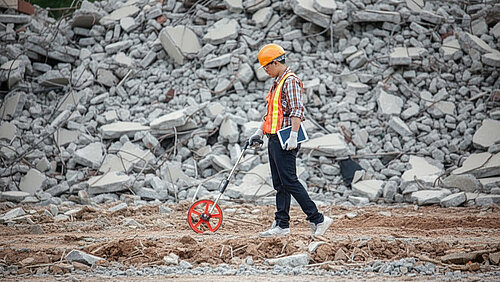
Guy Pushing a Measuing Wheel over Rough Terrain

Measuring Wheel 

+ Manual Calculation

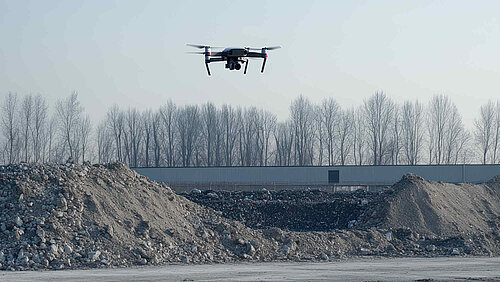
Done flying over a yard

Drone Photogrammetry

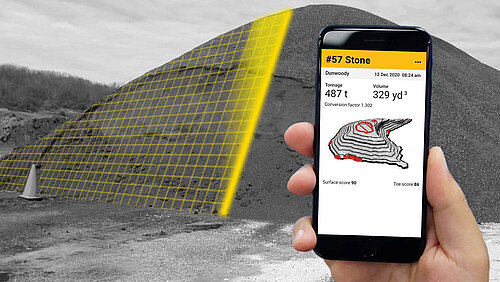
Mobile phone app to assess volume of a gravel pile

SR Measure®

iPhone 12 and newer + app

Why Accurate Stockpile Measurements Matter

Every stockpile represents money sitting on the ground.

For crushing contractors, a pile of recycled concrete could be a future revenue stream. For aggregate producers, inventory accuracy directly affects purchasing decisions, production scheduling, and month-end reporting.

A typical workflow starts with volume (m³ / yd³) and then converts that volume into tonnes using a material-specific density factor.

For example:

  • 2,000 m³ of crushed concrete
  • Density factor: 1.5 tonnes/m³
  • Estimated tonnage: 3,000 tonnes

Even a 5% measurement error can represent hundreds of tonnes of material—and potentially thousands of Euros in profit or loss.

That's why more operators are moving away from visual estimates and toward digital measurement tools.


However, the challenge is that there is no single density factor for concrete, asphalt, or rock. Material type, gradation, moisture content, and void space can significantly influence the result.

MaterialTypical Density Factor
Unprocessed demolition concrete1.6–1.8 t/m³ | 1.35 - 1.52 US st/yd³
Crushed concrete (0–63 mm | 2½"- )1.8–2.0 t/m³ | 1.52 - 1.68 US st/yd³

Comparison

FactorWalk wheel + manual calcDrone photogrammetrySR Measure (phone)
Accuracy~5–15% off; assumes an ideal cone shape real piles rarely matchWithin 1–3%Within 5%
SpeedSlow — hand-measured and computed manually afterwardFast at scale — 10–15 piles in 20–40 minMinutes per pile, on the spot, no post-processing
Equipment & costLowest — a measuring wheel and a calculatorDrone, camera, photogrammetry software; higher up-front costs + per-surveyAn iPhone you already own; free option + paid plans
Skill / licensingNoneTrained/licensed pilot, airspace permission, weather windowNone
SafetyRequires climbing/walking on piles — the biggest hazardKeeps people off piles; care needed flying over live operationsCapture from the ground, walking around the pile
Best forA rough back-of-envelope on one small, regular pileLarge open sites, many piles, periodic survey programmesEveryday on-site counts by one person; indoor/tight yards


Bottom line: If you need to survey an entire quarry once a quarter, a drone may be the right tool. If you prefer the hard way, a measuring wheel is a cheap option. But if you need to know how much concrete, asphalt, or aggregate is in a pile right now, SR Measure® is the most practical stockpile volume estimation tool available in 2026. It delivers fast, reliable results with minimal equipment, making it the best fit for everyday use on active crushing and aggregate sites.

Measure a Pile from Your Phone