
The State of Mobile Crusher Electrification in 2026
Is the Hype Over?

For the past few years, electrification has been the loudest story in mobile crushing.
Every OEM suddenly became “electric.”
Every trade show was filled with green messaging.
And every brochure promised a zero-emission future.
Now in 2026, the noise has reached its peak.
So let’s ask the uncomfortable question: “Was electrification ever real—or was it just the biggest marketing wave the industry has seen?”
In the previous years, the industry has seen a flood of announcements:
Manufacturers who ignored electrification for decades are now presenting it as their latest innovation.
Let’s be honest:
Much of what is being marketed today as “new” has already existed—and been proven—for years.
For many manufacturers electrification has become a checkbox.
A badge.
A must-have label for staying relevant.
👉 But here’s the problem:
Building an electric machine is not easy if you mainline portfolio is based on hydraulics
RUBBLE MASTER has manufactured electrified mobile crushers for more than 35 years.
Most competitors are still focused on brining out more “electric variants”.
But the market has already moved past that.
Because the real challenge is no longer inside the crusher. The real challenge is the energy infrastructure.
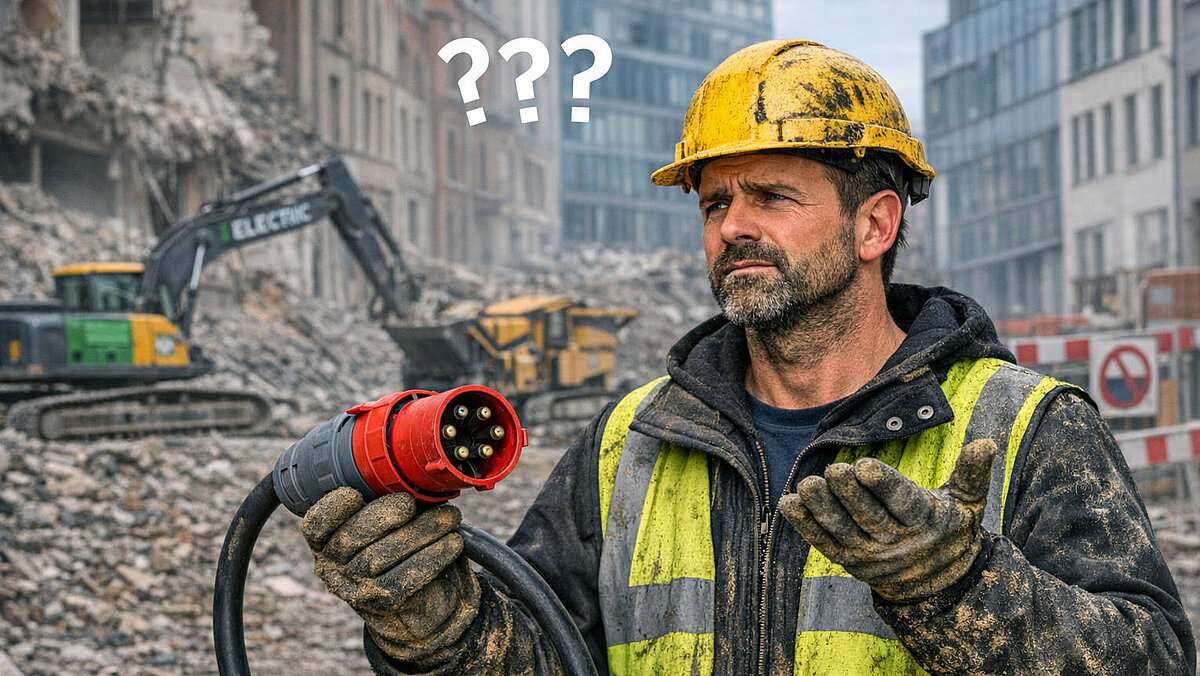
Most operators face limited grid access and the high energy demand of mobile crushers. Providing the energy demand of a mobile crusher requires the energy provider put down the right gauge cables which are so thick and stiff that we almost talk about a stationary setup once connected.
Yes—small electric machines work.
Mini excavators, compact loaders, mobile screening plants—no problem. But once you go beyond roughly 50 kW everything changes.
Electrification doesn’t fail at the machine level.
It fails at the jobsite level.
And this is where most “electric solutions” collapse.
For decades, the model for mobile crushing equipment was simple:
Now? Electrification has quietly changed the rules:
Let’s call it what it is: electrification requires more homework on the customer side.
And many customers are only now realizing what that means.
Yes, there is a clear trend when it comes to electrified yellow iron:
But the reality on the ground is different:
Even in highly electrified markets like Norway—where adoption is already advanced—the limitation becomes obvious: the power supply for large consumers simply isn’t there.
A crusher with >200 kW connected load can run in a dedicated industrial setup—but typical urban construction sites are not designed for it. In practice, most sites cannot run a mobile excavator and a crusher at the same time using grid power.
Providing the required power supply involves significant effort—large transformers, heavy cabling, and complex setup—turning a “mobile” solution into something close to a stationary installation.
So the industry keeps promoting…
A solution that only works under perfect conditions
Another uncomfortable truth: subsidies have not fixed the problem.
Across Europe, the situation is chaotic:
Hybrid? Often excluded.
Infrastructure? Rarely covered.
Application? Highly restricted.
👉 Result: subsidies drive the demand for electric crushers and lower the bar for first movers.
In some markets, subsidies are now focused on fully electric machines without diesel engines (e.g., fully electric tracked solutions like the RM 100XE). This creates a growing disconnect between what is incentivized (fully electric) and what actually works on real jobsites (hybrid, flexible solutions).
While the industry focuses on emissions, it’s missing a much more important point: Electrification simplifies machines.
In many cases, rewinding an electric motor is simpler than repairing a mechanical clutch or hydraulic assembly. Replacing a breaker is easier than fixing a hydraulic line.
This is where real operational value is created.
But it doesn’t make headlines—so it’s often ignored.
The next phase of competition is already starting.
And it has nothing to do with who builds the next electric jaw.
It’s about: who can make electrification simple.
The winning model will look like this:
Delivered as one:
A plug-and-play, jobsite-ready energy ecosystem
👉 Not theory.
👉 Not concepts.
👉 A system that works immediately.
We are already seeing electric fleets in controlled environments (ports, logistics hubs, bus lines).
Yes.
And that’s exactly what the industry needed.
Because hype hides the truth.
And the truth is not every electric machine works in every application and infrastructure is the real limiting factor.
Electrification is no longer about who can launch a product fastest.
It’s about who understands:
Anyone can build an electric crusher.
Very few know how to make it work.
And that is where the real separation in the market begins.
While much of the industry is still “launching” electric machines, RUBBLE MASTER has already spent decades refining them in the field. Electrification at RM is not a trend. It’s the foundation of how the machines have been built for over 35 years.
From the beginning, RUBBLE MASTER focused on diesel-electric drive systems—long before electrification became a buzzword. Today, this experience translates into a complete portfolio:
But the real difference is not the hardware. It’s the understanding of how electrification performs under real conditions—across recycling, quarrying, and contracting applications worldwide.
RUBBLE MASTER didn’t enter electrification late. It has been setting the standards others are now trying to match.
And that shows in what actually matters to customers:
Anyone can introduce an electric machine today. But only a few manufacturers have proven—over decades—how to make electrification work in the real world.
RUBBLE MASTER is one of them.

Join over 16,000 people who get our practical crushing & screening tips once a month.
